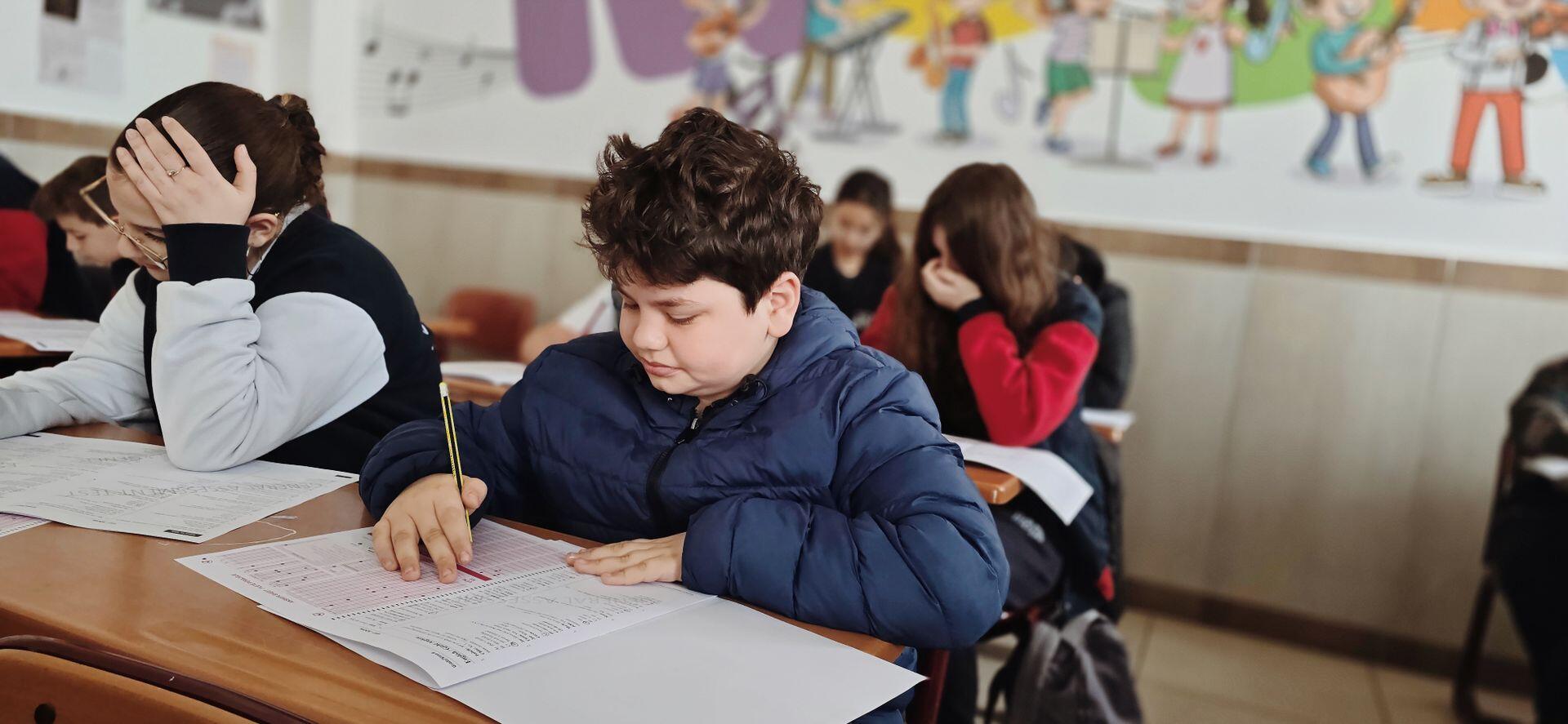

Have you ever wondered how much of what students learn at school actually helps them make sense of the world beyond the classroom?
A student may be able to solve an equation, interpret a passage, or recall a scientific fact in an examination. But what happens when the question looks different, and practical knowledge must be applied? This is where PISA comes into the picture.
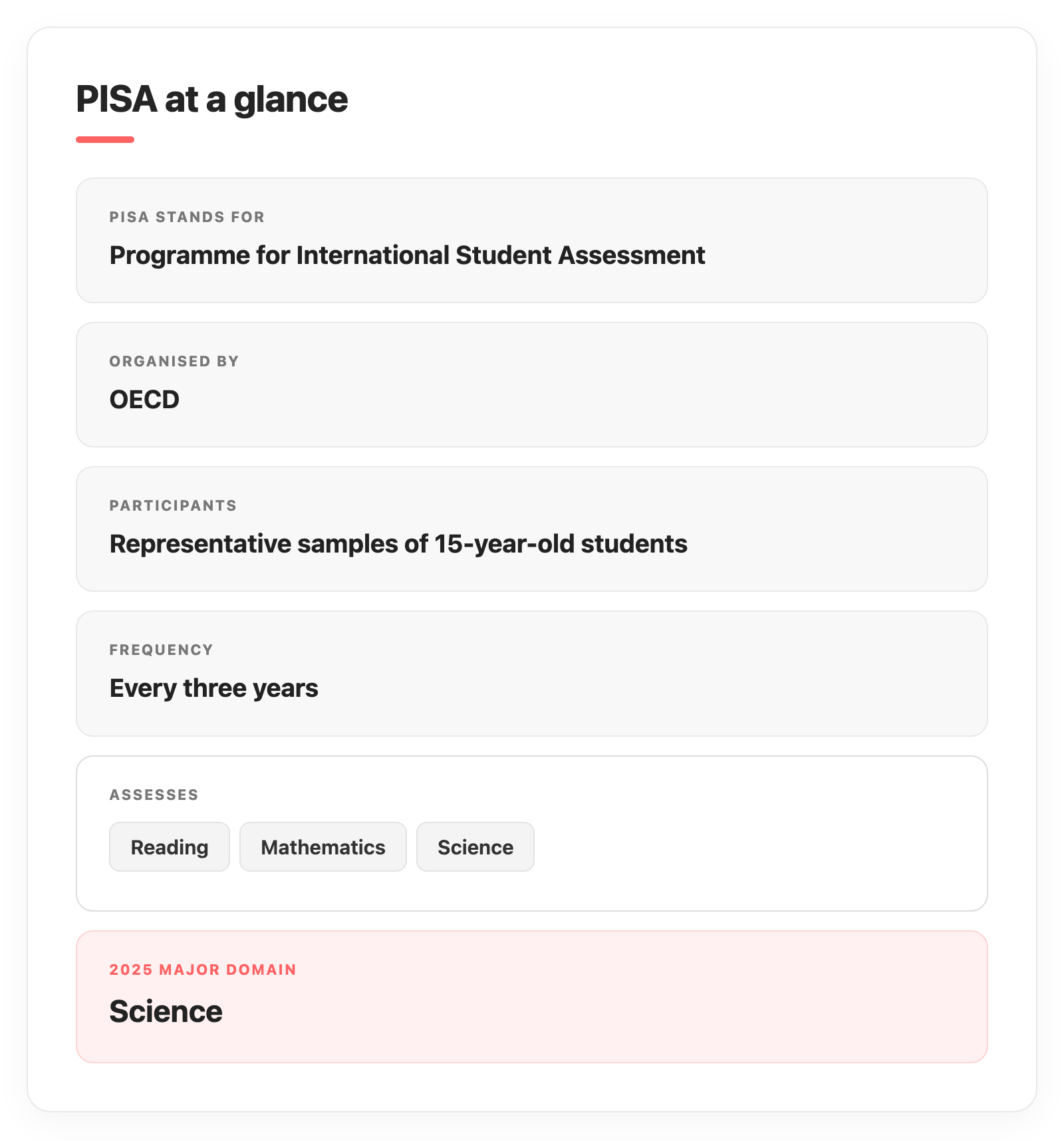
The Programme for International Student Assessment (PISA) is an OECD international assessment of 15-year-old students that measures how well they can apply their knowledge and skills in reading, mathematics, and science to real-world situations. 1


What You Need to Know About the PISA Assessment
PISA: Significance in the Education Context
Now, let’s look at PISA in a broader analytical context, moving from the international overview to the perspective of an individual country—the UK.

What is PISA Designed to Assess
PISA is designed to assess students' proficiency in the three core domains with the following indicators. 2
| PISA domain | Concise definition |
|---|---|
| Science | The ability to engage with science-related issues and ideas, and use them to make informed decisions as a reflective citizen. |
| Mathematics | The ability to reason mathematically and formulate, use and interpret mathematics to solve real-world problems. |
| Reading | The ability to understand, use, evaluate, reflect on and engage with texts to achieve goals, develop knowledge and participate in society. |
Essentially, PISA provides internationally comparable evidence that helps benchmark and understand the participating countries' education systems' performance, especially over time. It is designed to inform system-level comparisons and policy, rather than to produce individual student scores.
Why PISA Matters
As a participating country in the PISA assessment, the UK has benefited from the findings of the assessment in these specific areas:
- Identify long-term trends and areas requiring attention, especially in specific domains
- Look into education gaps of students associated with socio-economic backgrounds
- Learn from the policies and practices of other participating education systems
The United Kingdom first participated in PISA in 2000, but due to low school and student response rates, results from the UK are considered comparable only from 2006 onwards. 3
Inside the PISA Examination: Format, Domains and Question Types
Moving on, let’s look at how the PISA assessment is conducted and the types of questions it typically includes.
Computer-Based Assessment and Question Design
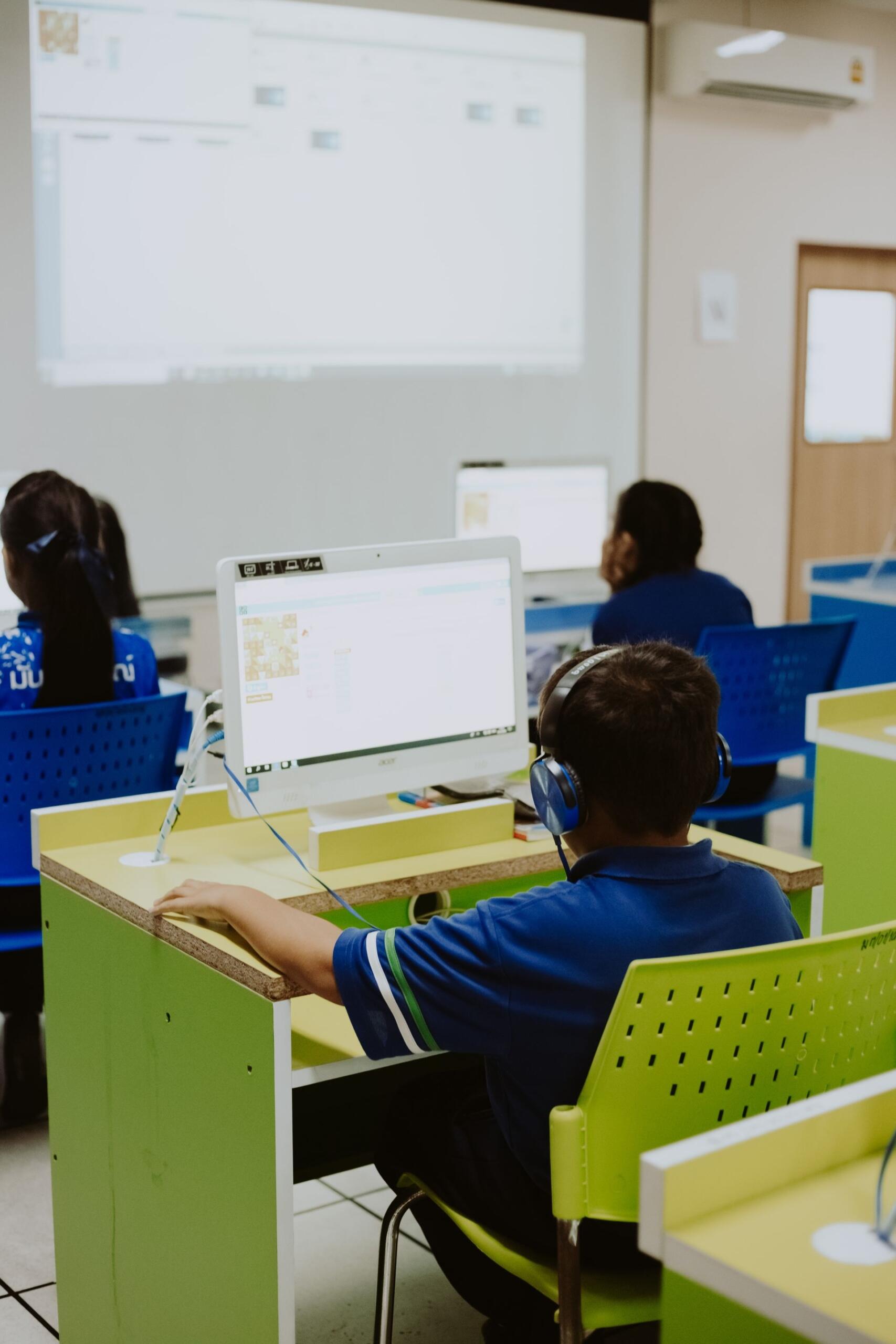
PISA is a computer-based two-hour test, covering science, reading, mathematics, and Learning in the Digital World (for the 2025 cycle). 4
The assessment uses multiple-choice questions as its primary format, ranging from:
Core Domains: Reading, Mathematics and Science
Reading, mathematics and science are assessed in every cycle. In 2025, science receives greater emphasis.
| Domain | What it focuses on | Example task types |
|---|---|---|
| Reading | Understanding, using and reflecting on written texts in everyday contexts. | - Summarising the main idea of an article - Comparing two short texts with different viewpoints - Locating specific information in a timetable or webpage |
| Mathematics | Applying mathematical reasoning to real‑world situations, not just school exercises. | - Interpreting graphs/tables about prices or travel times - Estimating quantities for a recipe or budget - Using proportions to compare mobile‑phone plans |
| Science | Engaging with science‑related issues, explaining phenomena and using evidence. | - Evaluating claims about vaccines or climate data - Designing a simple fair test for plant growth - Interpreting experimental results to draw conclusions |
Background Questionnaires
The PISA assessment is not limited to just test questions. Students and school leaders (principals) also need to complete computer-based background questionnaires (about 35 minutes), which capture contextual information to interpret the performance of students in the following areas:
📍Learning environment
📍Education resources
📍School policies
The PISA Programme Cycle
Now, let's look at the new developments in the PISA programme cycle.
First and foremost, PISA 2025 returns to science as the major assessment domain and introduces an upgraded framework. 5
The framework broadens its focus beyond scientific knowledge and literacy to the outcomes students need to participate meaningfully in society.
Greater emphasis is placed on evaluating evidence and scientific information, making informed decisions and applying science in real-world contexts.
Environmental challenges, misinformation and decision-making connect science with questions of agency, responsibility and action.
This cycle also introduced Learning in the Digital World (LDW) and offered an optional assessment of English as a foreign language. LDW assesses students’ ability to engage in self-regulated learning and computational problem-solving using digital tools. 6
Find out more about the PISA rankings.
Fieldwork, Scoring and Reporting Timeline
Have you ever wondered how long the PISA international assessment actually takes—from the development of its framework all the way to the publication of its final report?
Here's an overview of the timeline and the main work that goes into making the test.
Framework & item development
OECD and countries agree on what “reading/math/science literacy” means for that cycle and write new questions.
(2–3 years before fieldwork)
Translation, adaptation & pilot testing
Materials are translated, culturally adapted, and piloted to check difficulty and fairness.
(~1 year before fieldwork)
Main fieldwork
15-year-old students complete the PISA assessment during the designated assessment period.
Assessment year
Data cleaning, scaling & analysis
Responses are scored, scaled, and analysed to produce country‑level estimates and trends.
(~12–18 months after fieldwork)
International report & country notes
OECD publishes global results (Volume I, II, etc.) and country‑specific notes; national agencies may add their own reports.
(around 18–24 months after fieldwork)
UK Snapshot: How UK Schools Perform in PISA
Based on the PISA 2025 results, students in the UK scored higher than the OECD average in the mathematics, reading, and science domains.
Overall Performance and Trends
- Out of the three domains, the UK's science performance improved as our science score rose 11 points from 500 in 2022 to 511.
- The mean scores for mathematics and reading were broadly stable, at 488 and 494, respectively.
- The UK remained a high-performing system internationally — the UK was among the top 10 education systems overall across the three core domains.

PISA vs National Exams: What's the Difference?
There is one important distinction we need to be clear about: PISA is not designed to replace national examinations in the UK. The two serve different purposes, with different testing formats, areas of focus, and ultimately, different takeaways.
PISA provides an international lens on how well 15-year-olds can apply what they have learned to real-world challenges, whereas national examinations are designed around the specific curriculum of the UK education system.
PISA
- Purpose: Compares education systems internationally
- Who is assessed: A representative sample of 15‑year‑olds in each participating country
- What is measured: Competency in reading, maths, science (application in real life)
- Stakes for students: No stakes, as results do not affect grades or progression
- Frequency: Every 3 years (moving to 4 after 2025)
UK national exams
- Purpose: Individual qualifications for students to further study
- Who is assessed: All registered students in a year group
- What is measured: Curriculum-based proficiency in specific subjects according to the national syllabus
- Stakes for students: High, as grades influence school options, university entry, and even job applications
- Frequency: Annual exam series for GCSEs and A-Levels
Preparing Students: Can You “Revise” for the PISA Assessment?
As PISA is not a syllabus-focused assessment, you can't really revise it the same way as you do for your end-of-year exams.
Important Skills and Classroom Examples
PISA's main focus is how students from each participating country apply knowledge and skills to examine, interpret, and solve problems.
Unlike examinations, which are tied to a national syllabus and specific test questions, PISA focuses on broader skills that students can practise, and educators can bring to life through examples such as:
Understanding and Using PISA Data Responsibly
As a global assessment, PISA is likely to remain an important part of the international education landscape. Here's how we can interpret PISA results reliably.

What PISA Can Tell Us (and What It Can’t)
This test has its strengths and limitations, as the results are best understood as large-scale indicators, not as complete judgements about individual students, schools or national education systems.
For example, if one country achieves higher mathematics results than another, PISA can show the difference and examine how performance relates to factors such as socio-economic background. However, it cannot prove that one specific teaching method, examination policy, or government decision caused the higher score.
| PISA can tell us | PISA can’t tell us |
|---|---|
| How student performance compares internationally. | How every individual student or school performs. |
| How performance changes over time. | The full quality of an education system. |
| How results vary between different student groups. | Why one country or group performs differently. |
| How performance relates to factors such as socio-economic background. | A simple cause-and-effect explanation for differences. |
| Broad patterns in knowledge and skills among 15-year-olds. | A complete picture of learning, teaching or students’ educational experiences. |
Where to Find Reliable PISA Results and Methodology
The best way to assess reliable PISA data and methodology is through the official OECD and individual country pages.
| Resource | What you’ll find | Official link (just click) |
|---|---|---|
| OECD Education GPS | Country profiles, PISA scores, indicators and comparisons | UK — PISA 2025 Education GPS |
| PISA Country Notes | Concise summaries of PISA 2025 results for individual countries | UK — PISA 2025 Country Note |
| PISA Data & Methodology | Datasets, technical documentation, frameworks and methodology | PISA Data & Methodology |
| PISA 2025 Database | Full datasets, codebooks, questionnaires and data files | PISA 2025 Database |
| PISA 2025 Reader’s Guide | Guidance on interpreting scores, comparisons, uncertainty and reporting | PISA 2025 Reader’s Guide |
Glossary: PISA Terms Explained
Here are some terms that you will come across as you read through the reports.
| Term | Definition |
|---|---|
| Major domain | The subject area receiving the main focus in a particular PISA cycle, with more extensive assessment. |
| Proficiency levels | Performance bands describing what students can typically do at different levels of achievement. |
| Sampling | The process of selecting a representative group of schools and students to participate in PISA. |
| Background questionnaire | Questions that provide context about students, their backgrounds and learning environments. |
| Country note | A concise OECD summary of the key PISA results and findings for a participating country or economy. |
| PISA-D | PISA for Development — an OECD initiative adapting PISA to better reflect the contexts of low- and middle-income countries. |
| Education GPS | The OECD’s online education data platform, providing country profiles, indicators and international comparisons. |
| OECD average | The average performance across OECD countries participating in the relevant PISA assessment. |
| Statistical significance | An indication of whether an observed difference is unlikely to be explained by sampling variation alone. |
We hope you have enjoyed reading this article and gained some insights on what the PISA assessment is all about.
References and Further Reading
- Organisation for Economic Co-operation and Development. “Student Performance (PISA).” OECD, 19 June 2024, https://www.oecd.org/en/topics/student-performance-pisa.html. Accessed 7 Oct. 2026.oecd
- Organisation for Economic Co-operation and Development. “What Is PISA?: PISA 2025 Results (Volume I).” OECD, 8 Sept. 2026, https://www.oecd.org/en/publications/pisa-2025-results-volume-i_73451bc5-en/full-report/what-is-pisa_d18121f2.html. Accessed 7 Oct. 2026.
- Organisation for Economic Co-operation and Development. “PISA 2022 Results (Volume I and II)—Country Notes: United Kingdom.” OECD, 5 Dec. 2023, https://www.oecd.org/en/publications/pisa-2022-results-volume-i-and-ii-country-notes_ed6fbcc5-en/united-kingdom_9c15db47-en.html. Accessed 7 Oct. 2026.
- Organisation for Economic Co-operation and Development. PISA 2025 Technical Standards. 2025, https://www.oecd.org/content/dam/oecd/en/about/programmes/edu/pisa/publications/technical-standards/PISA_2025_Technical_Standards.pdf. Accessed 7 Oct. 2026.
- Organisation for Economic Co-operation and Development. “PISA 2025 Science Framework.” PISA Framework, n.d., https://pisa-framework.oecd.org/science-2025/. Accessed 5 Oct. 2026.
- Organisation for Economic Co-operation and Development. “PISA 2025 Learning in the Digital World.” OECD, 2024, https://www.oecd.org/en/topics/sub-issues/learning-in-the-digital-world/pisa-2025-learning-in-the-digital-world.html. Accessed 7 Oct. 2026.
Summarise with AI:
Did you like this article? Leave a rating!

 Loading...